
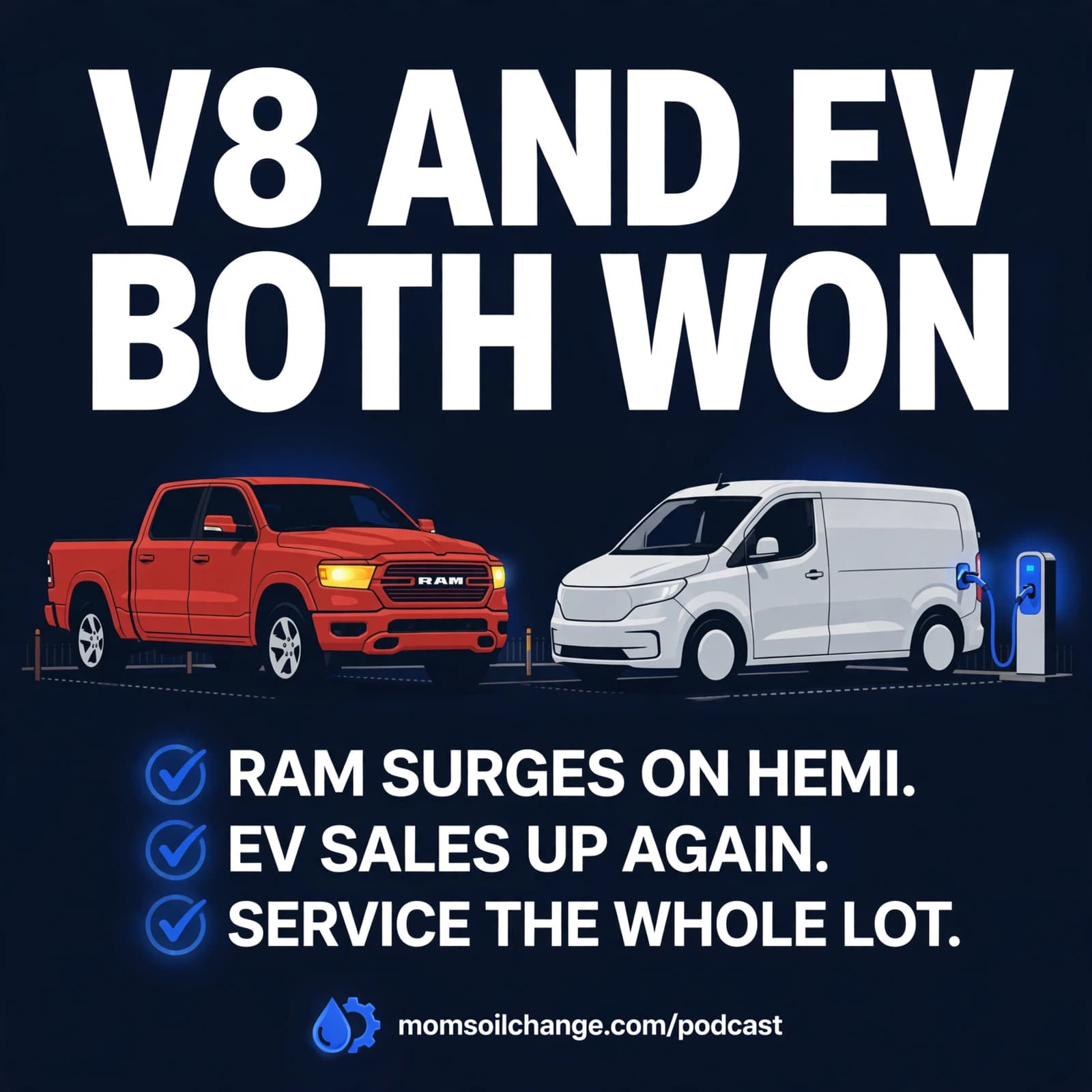
Ram V8 Sales Surge as EV Sales Rebound
Marcus, Zoe, and David on Stellantis Q3 shipments, the Ram Hemi V8 comeback, the Q3 EV rebound, and what a mixed-powertrain fleet means for operators.
Share this episode
Every share includes a caption, call to action, and hashtags — just pick your platform.
🎙️ Ram V8 Sales Surge as EV Sales Rebound Marcus, Zoe, and David on Stellantis Q3 shipments, the Ram Hemi V8 comeback, the Q3 EV rebound, and what a mixed-powe... Press play and listen 👇
https://momsoilchange.com/podcast/ram-v8-sales-surge-as-ev-sales-rebound-2026-10-14
#MobileOilChange #momsoilchange #servicewriter #AutoIndustry #SmallBusiness #PhillyBusiness
LinkedIn doesn't accept pre-filled text — we copy the caption for you automatically.
Full Transcript
Marcus: Welcome back to the show. Look, I have got a question for everybody listening. Is the gas engine dead, or is it just getting started again? Because in the last two days, we got two headlines that sound like they contradict each other, and I think they actually tell one story. Zoe: Okay, I love a contradiction. Lay it on us. Marcus: Here is the thing. Stellantis put out their third quarter numbers yesterday, Tuesday, October thirteenth. One point three million vehicles shipped worldwide, down about one percent from a year ago. North America down twelve percent, and they said that was planned shutdowns, not a collapse. Jeep Grand Cherokee and Compass each dropped about twenty-five thousand units while the plants were down. David: And the offset was Ram. Marcus: The offset was Ram. Ram shipments went up about seventeen thousand units, and Stellantis said it straight out. Demand for the Ram fifteen hundred with the Hemi V eight, plus the new Ram fifteen hundred T R X. People keep saying the V eight is finished, and then the truck with the V eight in it carries the whole quarter. Zoe: Okay but why is nobody talking about the second headline, because it is just as loud. Monday, October twelfth, Electrek reported the Kelley Blue Book numbers. Two hundred sixty-six thousand six hundred thirty electric vehicles sold in the United States in the third quarter. That is up seven point seven percent from the second quarter, and it is the best quarter for E Vs in a full year. Marcus: Now hold on, because the year over year number tells the other half. Down thirty-eight point six percent from a year ago. Zoe: Right, and that is the tax credit cliff, not a demand collapse. The seven thousand five hundred dollar federal credit expired at the end of September last year, so everybody rushed to buy in the third quarter of twenty twenty-five. That made this year look terrible by comparison. But quarter to quarter, the market is climbing again. E Vs were six point five percent of all new car sales, up from five point eight percent in the second quarter. David: So both things are true at once. The V eight truck is surging, and the E V market is recovering. That is the story. It is not a winner take all market. It is a split market. Marcus: Exactly. And here is what that means from the driver's seat. We have done this a hundred times. A customer rolls up in a Ram fifteen hundred with a Hemi, and he wants to talk about his truck. He is proud of that engine. He is not apologizing for it. He is asking me when his next oil change is due, because that truck earns him a living. That vehicle needs us every five or six thousand miles, and there are a whole lot of them on the road. Zoe: And meanwhile the E V owner is a totally different content opportunity, and most shops are blowing it. The algorithm loves this. People are searching, do E Vs need oil changes, do E Vs need maintenance, what breaks on a Tesla. If your shop is not answering those questions on video, somebody else is, and they are getting the customer. Marcus: Nah. That does not make sense to me, though. An E V does not need an oil change. What are we selling them? Zoe: You are selling them everything else. Tires wear out faster on E Vs because the cars are heavier. Cabin filters, brake fluid, coolant for the battery, wiper blades, inspections. And the biggest thing, trust. The E V owner does not know where to take their car, because the dealer told them it never needs anything, and then the tire bill shows up. If you are the shop that explains it straight, you own that customer. David: Let us run the numbers on that, because this is where it gets interesting for fleets. In the top ten list from Kelley Blue Book, through the third quarter, the Tesla Model Y is still number one at two hundred sixty-two thousand four hundred ninety-one sold this year. The Model Three is number two. But look at number eight. The Rivian delivery van. Fifteen thousand six hundred eighty-five of them this year, up one hundred thirty point four percent from last year. Marcus: Delivery vans. That is fleet business. David: That is fleet business. Amazon-style vans, last-mile delivery, running all day, stopping and starting a hundred times. Those vans do not need oil changes, but they chew through tires and brakes, and they need somebody watching the whole vehicle. At fleet scale, a fleet manager does not care what powers the van. They care whether it rolls at six in the morning. The contract is the product. Marcus: So what does the fleet manager actually buy? Because I keep hearing operators say, E Vs are killing my business, and I am sitting here thinking, your business was never oil. Your business was keeping vehicles on the road. David: That is exactly right. A mixed fleet contract is worth more than a gas-only contract, because it is harder to run. You are tracking oil intervals on the Ram trucks, tire wear on the E Vs, brake life on both, and one report that covers the whole lot. The operator who can service the whole lot wins the contract. The operator who only does oil changes watches the contract go to somebody else. Zoe: And the content side of that is free money. Film the split lot. One side, the Ram getting its oil changed. Other side, the Rivian van getting tires and a full inspection. Same shop, same crew, same morning. That video answers the only question customers actually have, which is, can these people take care of my vehicle, whatever it is. That would absolutely eat on TikTok. Marcus: Look, I will be honest. A year ago, I was the guy saying E Vs were a problem for shops like ours. I do not know yet how fast the mix changes, but let us figure it out out loud. The numbers from this week say the mix is changing slowly. Six point five percent of new sales is E V. That means ninety-three point five percent is not. The gas truck is not going anywhere this decade. David: And the other side of that math is just as important. Stellantis shipped one point three million vehicles in a quarter, and Europe grew ten percent on battery electrics. The direction is real. You do not have to panic, and you do not get to ignore it either. You build for both. Zoe: Which is the best possible position for a small operator, honestly. The big chains are built for one thing. A quick lube chain is built to move gas cars through a bay in fifteen minutes. A dealer is built to sell you a new car. A mobile operator can show up at the fleet lot and service the Ram and the Rivian in the same visit. Nobody else is set up to do that. Marcus: That is the takeaway, then. Stop picking a side in the gas versus electric argument. The argument is over, and both sides won. Your job is to service the whole lot. David: One program, one invoice, one report. Gas trucks get oil, filters, and inspections. Electric vans get tires, brakes, filters, and inspections. The customer gets one phone call that covers everything. Zoe: And tell that story on camera. The split lot video, the side-by-side service, the honest answer to do E Vs need maintenance. The algorithm loves this, because nobody else in our industry is saying it this clearly. Marcus: That is it for today. Zoe: Go make something worth watching. David: And run your numbers. Marcus: See you tomorrow.
New episodes every weekday. Subscribe via RSS to get them in your podcatcher.
Book Your Oil Change