Oil Change Under Threat: The Car Wash App
Marcus, Zoe, and David on Korean car-care app Sejinsa's move from on-site washing into engine oil and tires with AI photo inspections, plus AI fleet dispatch and the booking platforms coming for the driveway.
Share this episode
Every share includes a caption, call to action, and hashtags — just pick your platform.
🎙️ Oil Change Under Threat: The Car Wash App Marcus, Zoe, and David on Korean car-care app Sejinsa's move from on-site washing into engine oil and tires with AI p... Press play and listen 👇
https://momsoilchange.com/podcast/oil-change-under-threat-the-car-wash-app-2026-10-15
#MobileOilChange #momsoilchange #servicewriter #AutoIndustry #SmallBusiness #PhillyBusiness
LinkedIn doesn't accept pre-filled text — we copy the caption for you automatically.
Full Transcript
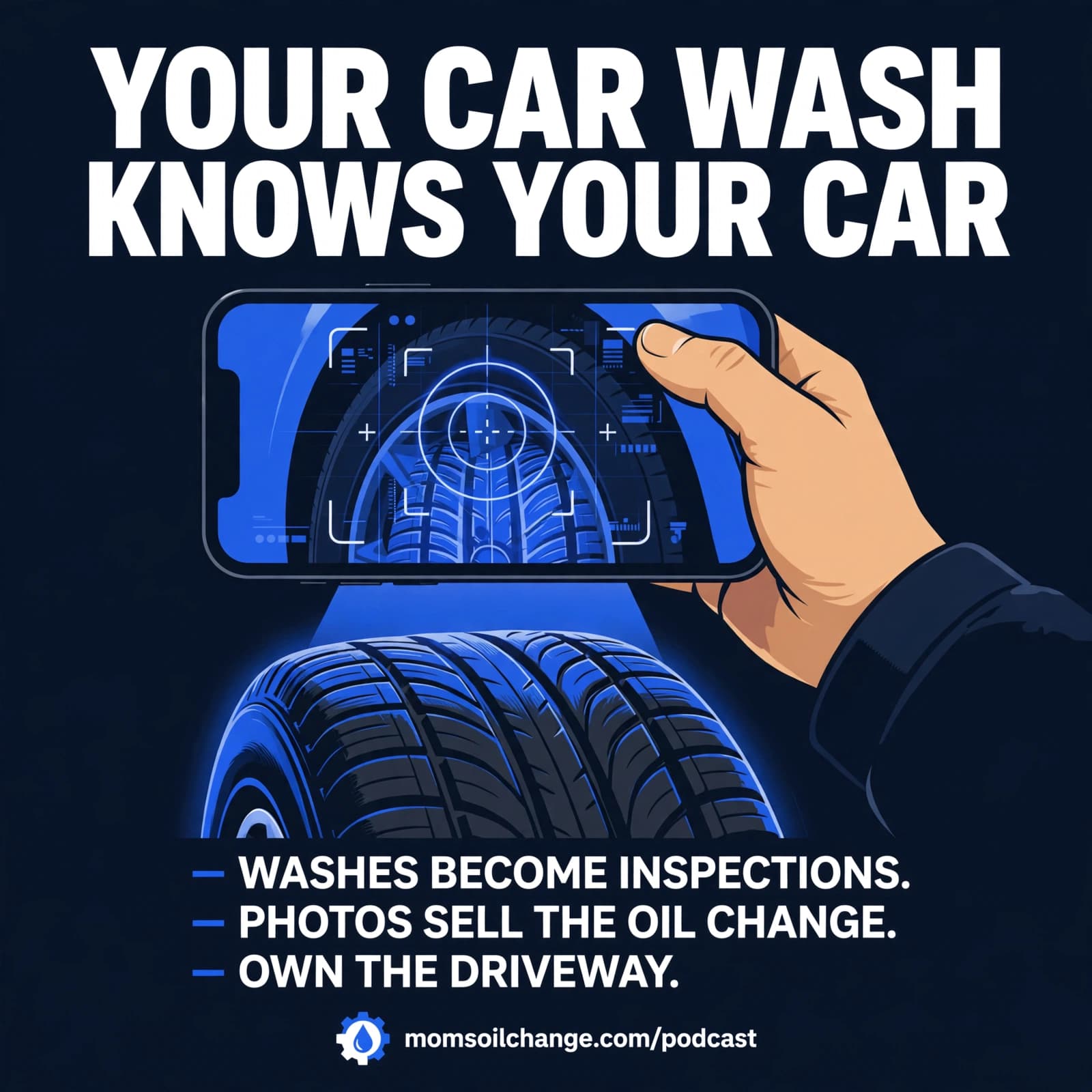
Marcus: Something happened this week that I cannot stop thinking about, and it is not from a car company. It is from Korea. A car wash app — Sejinsa, spelled S-E-J-I-N-S-A — just raised bridge funding, got picked for a Korean government tech program called TIPS, and here is their plan. They already come to your parking spot and wash your car. Sixty thousand washes so far. Four thousand crews. And now they do engine oil and tire replacement too. And here is the part that got me. Their crews photograph your car at every single wash, and they are training artificial intelligence to read those photos — exterior damage, engine oil condition, battery health, tire condition. So the wash visit becomes the inspection. They know your car needs an oil change before you do. Look… that is the play. That is the whole play.
Zoe: Okay but why is nobody talking about the business model math here? Car washing is the most frequent thing a car owner pays somebody else to do. That is their founder's entire argument — the wash is the trojan horse. You wash a car six, eight times a year, you get six or eight looks at that vehicle. Six or eight photo sets of the same car, building a history. Nobody else in the service chain sees that car that often — not the dealer, not the lube shop, not the tire store. So Sejinsa is not building a wash company. They are building a data collection company that happens to wash cars, and the oil change is just what they sell once the data says it is time. That would absolutely eat on TikTok, by the way — imagine the content: "we flagged your tire wear three visits before you noticed."
Marcus: I do not know yet, let us figure it out — does the photo thing actually work? A wash crew is not a technician. You are telling me a twenty-year-old with a pressure washer is going to judge my engine oil condition from a photo? I have been wrong about tech before, but here is the thing… even if the artificial intelligence is only right half the time, it still changes the game. Because now the upsell comes with a photo. "Look at this." That is a hundred times more powerful than my tech saying "your oil looks dark." I do not love it, but I respect the mechanism.
David: Let us run the numbers on that from the fleet side, because this is where it gets real for me. The founder, Yongbin Yoon, their chief executive, said this — and I am paraphrasing the spirit — car washing is the maintenance service car owners use most often, so they want the service that uses wash data to proactively tell you what your car needs. That is a maintenance curation model. At fleet scale, the contract is the product, and the contract is won by whoever can prove they see the problem first. If a platform can show a fleet manager a dashboard that says seventeen of your two hundred vehicles have tires aging out in the next thirty days, that is not an oil change anymore. That is fleet uptime insurance.
Zoe: And the incumbents are already proving the model from the other direction. Hyundai's truck and bus operation in the Philippines announced on Wednesday, October fourteenth — yesterday — a nationwide Before Service campaign: free thirty-five-point check-ups for commercial vehicles, diagnostics, the works, running through November. Dealerships doing the exact same move Sejinsa is doing: inspect first, monetize second. Everybody is converging on find-the-problem-before-the-breakdown. The only question is who owns the inspection.
David: There is a second data point from yesterday I want on the record. A Canadian company called Predictiv AI launched something called Flockentis — an artificial intelligence fleet decision engine. It takes up to five thousand jobs in a single planning cycle and generates Plan A, Plan B, and Plan C for dispatch — cost, punctuality, emissions — with vehicle health and driver hours factored in. Different product, same signal. The money is moving toward whoever owns the vehicle data. If you run a fleet maintenance program and you are not generating data with every visit, you are a cost center. If you are generating data, you are a dashboard. Dashboards win contracts.
Marcus: Here is the thing though. Nobody has done this a hundred times. This is new, and it scares me more than another Valvoline opening across the street. A Valvoline is a building. I can out-service a building — I come to your driveway, they cannot. But Sejinsa is already in the driveway. They have got four thousand crews going to people's parking spots. The driveway was my moat. Now the wash guys have the moat. Nah. That does not make sense — I mean, it makes perfect sense, which is exactly why it scares me.
Zoe: Right, and here is what operators keep missing. The algorithm loves this. Not TikTok's algorithm — your customer's decision algorithm. Every time a Sejinsa crew shows up and does a good wash, that is a trust deposit. Then one day the app says, "Hey, the engine oil condition looked rough in last visit's photos — want us to handle it while we wash?" That is a warm upsell with a photographic receipt. Compare that to the postcard you mailed last quarter offering ten dollars off an oil change. One of these converts. It is the one with the photo. So if you are a mobile operator listening to this, the camera is now a revenue tool. Photo everything. Text the customer what you saw. That archive is your Sejinsa.
Marcus: Okay, but can we talk about the trust problem for a second? Because I am the guy who has to send a tech into somebody's driveway with a camera, and there is a line. A customer hired me to change oil, not to surveil their vehicle for a platform. If my tech photographs the car and two weeks later the customer gets a text saying "our system flagged your battery," that can feel creepy or it can feel like concierge service. The difference is consent and framing. We do this a hundred times — sorry, we do oil changes a hundred times — and the ones that go wrong go wrong on trust, not on torque specs. So the play is: tell them at booking. "We photograph your vehicle at every visit so we can catch problems early." Make it the feature, not the fine print.
David: That is exactly the operational question, and the answer is process. Consent in the booking flow. A thirty-second photo walkaround as a documented step in the work order. Condition notes attached to the vehicle record, not the tech's phone. Because here is the fleet version of the same trust problem: a fleet manager will not hand you a contract because you have photos. They will hand you a contract because you have photos, timestamps, condition history, and a report that shows up every month. Sejinsa's crews generate that for free, because the crew is already there washing. The marginal cost of data collection is zero. That is the number that should worry every shop that treats the inspection as a separate billable line item.
Zoe: And the platforms are closing in from the booking side too. Last week — Wednesday, October seventh — a U-S platform called Bookovia launched. It is an app that connects car owners with trusted local mechanics — clear pricing, real-time updates, pick your schedule and location. The founder's story is literally "I had a bad dealer experience, then a great mobile mechanic experience, so I built the app." Different flavor, same threat as Sejinsa: the relationship moves into an app, and the wrench work becomes the commodity. Okay, real talk — between the wash app that wants your oil change and the booking app that wants your customer relationship, the independent operator is getting squeezed from both sides unless they build their own direct channel.
Marcus: So here is what I tell my guys, for real. Every driveway visit is a Sejinsa visit waiting to happen. Take the photo of the tire. Note the oil. Text the customer what you saw. Build the vehicle record yourself, because if you do not, somebody's app will. And here is the part I actually like about the Korean story — it proves the mobile model wins. Sejinsa did not build shops. They built crews that go to parking spots. Sound familiar? That is us. They validated our whole thesis and then added the data layer on top. So the answer is not to fear the wash app. The answer is to become the wash app — for your customers, with your data, in your market.
Zoe: And make the record visible, because that is the content play that costs you nothing. You found a bald tire during an oil change — with the customer's permission, that is a post. "This customer came in for an oil change, we caught this." The algorithm loves this because it is real stakes, real expertise, real saves. Sejinsa is going to turn sixty thousand washes of photo history into a content and conversion machine. You can start the same archive with your next service visit. The camera is the marketing department now.
David: Two numbers to leave operators with. One: sixty thousand washes. That is sixty thousand vehicle-condition snapshots in about three years, from a company that started with nothing but buckets and vans. Two: the Korean tech program funding is eight hundred million won — roughly six hundred thousand U-S dollars — dedicated purely to the artificial intelligence recognition model. They are not guessing about this. The recurring touchpoint is the business. The oil change is the monetization. Build the touchpoint first.
Marcus: So here is the takeaway from the panel. Your next competitor for the oil change might not sell oil changes. They might sell washes. Or bookings. Or fleet dashboards. The thing they all have in common: they see the car more often than you do.
Zoe: So be seen more. Photo everything, text the customer, post the saves.
David: And run your numbers on visit frequency. If you are only in front of a customer twice a year, you are renting the relationship. Whoever is there monthly owns it.
Marcus: That is it for today. Zoe: Go make something worth watching. David: And count your touchpoints. Marcus: We will see you tomorrow.
New episodes every weekday. Subscribe via RSS to get them in your podcatcher.
Book Your Oil Change