The Quick-Lube Operator Who Bought the Oil Brand
Marcus, Zoe, and David on quick-lube operator Costa Kapothanasis buying 77-year-old lubricant maker Lubri-Loy — vertical integration, heritage as content, and training as retention.
Share this episode
Every share includes a caption, call to action, and hashtags — just pick your platform.
🎙️ The Quick-Lube Operator Who Bought the Oil Brand Marcus, Zoe, and David on quick-lube operator Costa Kapothanasis buying 77-year-old lubricant maker Lubri-Loy — verti... Press play and listen 👇
https://momsoilchange.com/podcast/the-quick-lube-operator-who-bought-the-oil-brand-2026-10-13
#MobileOilChange #momsoilchange #servicewriter #AutoIndustry #SmallBusiness #PhillyBusiness
LinkedIn doesn't accept pre-filled text — we copy the caption for you automatically.
Full Transcript
Marcus: Alright, welcome back to the show. Today's a good one, because it hits every lane we talk about on this show. A quick-lube operator just bought an oil company. Not a store. Not a franchise. The whole brand, top to bottom.
Zoe: Wait, like bought bought? As in, owns the oil now?
Marcus: Bought bought. Here's the thing. Yesterday, Monday, out of St. Louis, a guy named Costa Kapothanasis, goes by Costa, announced he acquired The Lubri-Loy Company. One hundred percent of it. He bought it from the longtime owner, David Graham, through a private holding company. Terms were not disclosed, which is the fancy way of saying we don't get to know the number.
Zoe: Okay but who is this guy? Costa Oils, that's like, a chain?
Marcus: Costa Oils Inc. He's the president and CEO, quick-lube operator out of Hanover, Pennsylvania, more than sixty quick-lube locations across multiple states. He also runs a performance filtration brand called Costa Filters. So this is a shop operator. A real one. And he just bought a seventy-seven-year-old oil brand.
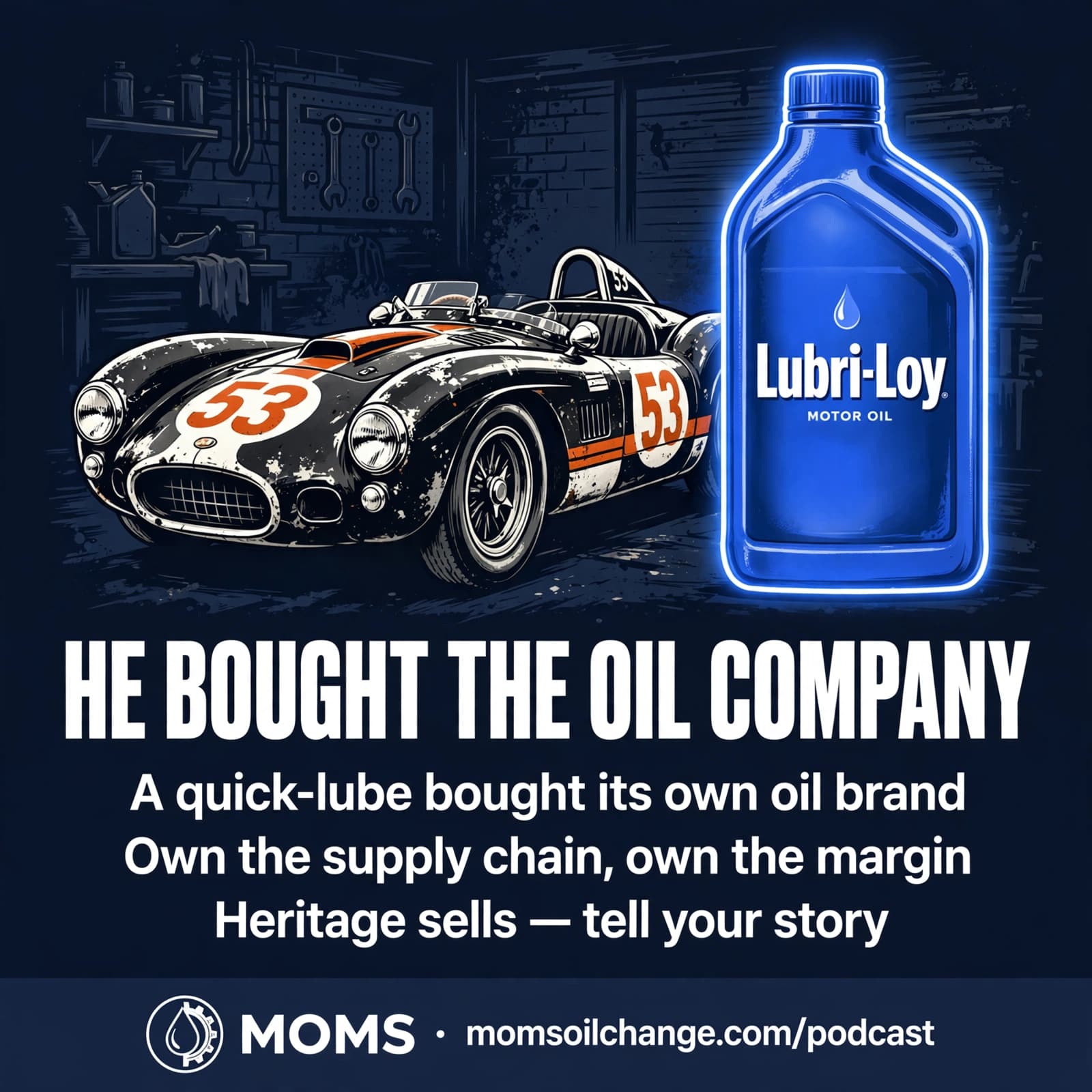
David: That's the part that got my attention. Let's run the numbers on what this actually means. Lubri-Loy was founded in nineteen forty-nine in St. Louis. Their first product was an oil additive made to free sticky valves. Same year Cadillac and Oldsmobile brought out their high-compression V-eight engines. The brand grew up alongside the modern American engine. And in nineteen fifty-three they were at the Indianapolis 500. The number sixty-two Lubri-Loy Special, driven by a kid from Missouri named Spider Webb, started eighteenth and finished nineteenth in the famous Hottest Five Hundred. That's not a footnote. That's a heritage asset.
Zoe: Okay but why is nobody talking about this as a marketing story? This is insane content. A quick-lube guy buys a seventy-seven-year-old oil brand with a race car history, and he announced it with a mascot? Did you see this? He's relaunching with a mascot called Lubri-Loy Roy. A black, white, and orange block-letter wordmark. A rebuilt website with a heritage archive of vintage ads and racing history. Zoe here would absolutely lose her mind over this playbook, because this is what I keep screaming about on this show. Nobody buys oil. They buy a story they can remember.
Marcus: Look, I get the mascot thing sounds cute, but here's the part I respect. The new owner said the history is the asset. He said the plan is simple. Keep every customer they have, tell the story this brand earned, and put Lubri-Loy back in the hands of people who turn wrenches for a living. Now that right there is an operator talking. He didn't buy a brand to be a brand guy. He bought it because he owns sixty stores that pour oil every single day.
David: At fleet scale, this is the interesting move. Think about what he's actually buying. He's buying supply-chain leverage. If you run sixty-plus locations, oil is one of your biggest variable costs, and you're at the mercy of distributors and blenders and base-oil pricing. Now imagine those sixty stores are launching a product line from a company you own. That's vertical integration. That's the margin you used to hand to someone else, staying inside your own building.
Marcus: We've done this a hundred times on a smaller level. Every shop has done the math on house-brand versus name-brand. Private label oil is how the big chains juice their margins. But this is different. This isn't white-labeling somebody else's barrels. He bought the blender, the name, the history, the whole thing. And here's the part that tells you he knows what he's doing. He's keeping the industrial side intact. Lubri-Loy under David Graham spent twenty-plus years building industrial oils, greases, food-grade lubricants, even export business in Asia. Costa said every product, every part number, every ordering channel, every distributor relationship stays. He's not breaking what's working to feed his stores. He's adding his stores on top.
Zoe: And I want to talk about Lubri-U, because buried in this announcement is a training platform. He's building a whole training and certification program for the Lubri-Loy team, a single library of technical documents. Now, as a content person, I'm sitting here going, why is a seventy-seven-year-old oil company building what is basically a course platform? And then it clicks. Training is retention. If you're a distributor or a tech and you've been certified by the brand, you don't switch brands. That's loyalty you can't buy with a rebate.
David: That's exactly right, and at fleet scale training is everything. The contract is the product, but the contract only holds if the people touching the equipment know what they're doing. A lubricant brand with its own training platform becomes the brand your techs were taught on. That's sticky. Now, zoom out with me. What does this signal for operators? We've been watching consolidation in store counts for years. The big chains buying up independents, the franchise mergers, all of it. This is consolidation moving one level deeper. Not buying stores. Buying the stuff that goes in the stores.
Marcus: Nah, that doesn't make sense is what some people are going to say, because sixty stores isn't exactly Valvoline. And look, they're right that this isn't about size. It's about control. When you own the brand, you control the price you pay, the story on the bottle, and where it gets stocked first. His announcement literally says the return to the service bay starts in his own sixty-plus locations. His stores are the launch pad. That's sixty built-in customers for the brand he just bought. You can't buy distribution like that. You can only own it.
Zoe: And can we just appreciate the audacity of the story here? A brand that was on the grid at the Indy 500 in nineteen fifty-three, that disappeared into industrial catalogs for decades, and now it's back with a mascot and a racing archive and a guy who actually runs stores saying it belongs under the hood again. That would absolutely eat on TikTok. You film the vintage ad archive. You film the nineteen sixty-five headquarters photo. You film the mascot on a bottle in your own bay. The algorithm loves this. Real history beats a polished commercial every time, and this guy has seventy-seven years of it for free.
David: There's a real lesson in the industrial-to-automotive arc too. Lubri-Loy started as an automotive additive, then moved to the factory floor under Graham. Premium lubricants, without premium prices, that was the promise, and it hasn't changed in seventy-seven years. The pivot back to the service bay isn't nostalgia. It's arithmetic. The automotive service market is where the volume and the visibility are. Industrial paid the bills. Automotive builds the brand. And when you own sixty stores, you've already solved the hardest part, which is getting the product into hands.
Marcus: So here's what I want operators to actually do with this story. First, look at your own shelves and ask whose name is on your highest-margin item, and whether that name is yours. Second, look at your own history, because some of you are sitting on twenty, thirty years of stories and you've never filmed a single one of them. And third, respect the quiet part of this deal. He bought from a guy who'd led the company for more than two decades. Graham said he was never going to hand it to someone who saw only a balance sheet. He said Costa knows this industry and respects where the brand came from. Deals like this happen because somebody showed up as an operator, not a spreadsheet.
Zoe: My takeaway is the content one, obviously. Your history is an asset whether you have seventy-seven years of it or seven. If you've been servicing the same neighborhood for a decade, you have a heritage archive too, it's just in your head and your photo roll. Get it out. Film it. The brand with the best story wins the customer before the price ever comes up.
David: And mine is the systems one. Audit your supply chain the way you'd audit a contract. Where does your oil come from, who's got leverage over your price, and what would change if you controlled one link of that chain? You don't have to buy an oil company. But you do have to know what it costs you not to be the one holding the bottle.
Marcus: That's the show for today. Zoe: Go film something real. David: And run your numbers. Marcus: We'll see you tomorrow.
New episodes every weekday. Subscribe via RSS to get them in your podcatcher.
Book Your Oil Change