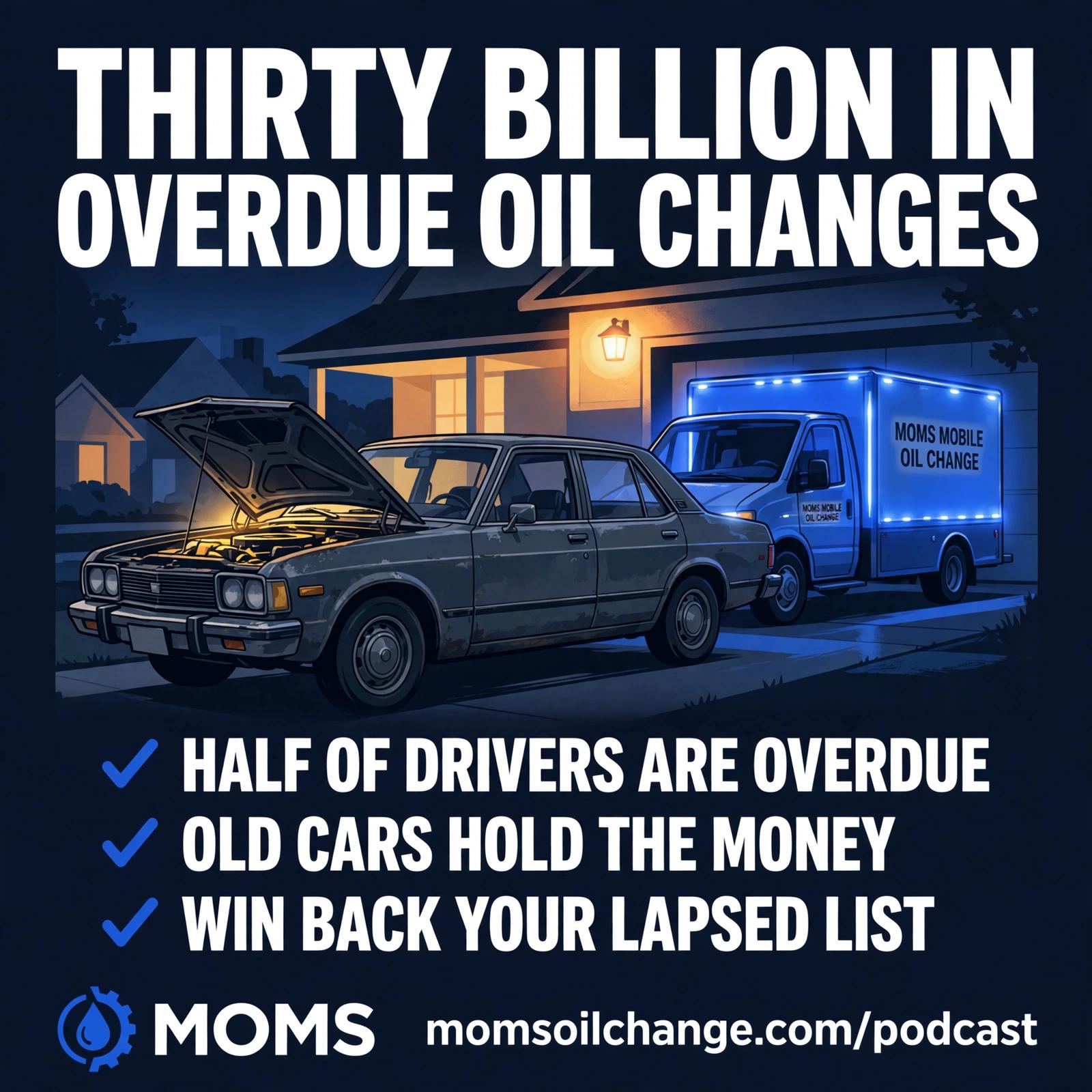
The $30 Billion Deferred Maintenance Goldmine
Thirty billion dollars of maintenance went undone last year — and oil changes were the most skipped job of all. Tyreese's five-move playbook for winning the lapsed customers back.
Share this episode
Every share includes a caption, call to action, and hashtags — just pick your platform.
🎙️ The $30 Billion Deferred Maintenance Goldmine Thirty billion dollars of maintenance went undone last year — and oil changes were the most skipped job of all. Tyree... Press play and listen 👇
https://momsoilchange.com/podcast/the-30-billion-deferred-maintenance-goldmine-2026-11-25
#MobileOilChange #momsoilchange #servicewriter #AutoIndustry #SmallBusiness #PhillyBusiness
LinkedIn doesn't accept pre-filled text — we copy the caption for you automatically.
Full Transcript
Tyreese: Look, tomorrow is Thanksgiving. Triple A says seventy-two point nine million Americans are getting in a car and driving somewhere this week. Seventy-two point nine million people, on the road, all at once. And here is the number nobody is talking about at the dinner table: more than half of those drivers are overdue for an oil change. Not a little late. Not pushing it a few hundred miles. Skipping it entirely.
Tyreese: I want to tell you where that comes from, because I do not want you taking my word for it. On Monday, National Oil and Lube News published a piece out of Aapex, the big aftermarket show in Las Vegas. The analyst is Nathan Shipley from Circana, and he tracks what American drivers actually do with their cars. His headline finding is that lower-income drivers are deferring maintenance at a rate he has not seen before, and the service they skip first is the oil change. That lines up with a Midas survey that came out on the sixth of October. Midas polled one thousand drivers across the country, and fifty-three percent said they delayed or skipped recommended maintenance in the past year. Half of those people said the reason was simple: they could not afford it. And the single most skipped service was the oil change, at thirty-three percent. One in three drivers skipped an oil change.
Tyreese: Then Aapex put out its own number at the end of October. Americans delayed thirty billion dollars of vehicle maintenance in twenty twenty-five. Thirty billion, with a B. And here is the part that should make every independent operator sit up: sixteen point five billion of that thirty billion is sitting in cars twelve years old or older. The average car on American roads right now is twelve point nine four years old, the oldest fleet in history. New car sales were suppressed for a couple of years, people are holding their cars longer, and there are twenty million more vehicles past their warranty than there were back in twenty twenty. That is the aftermarket sweet spot, and it keeps getting bigger.
Tyreese: So here is the thing. Most operators hear those numbers and they hear bad news. Fewer miles driven, customers deferring, do it yourselfers buying oil off the shelf. Shipley even said miles driven started dropping in late summer, and the drop got sharper in the early fall. And yes, Circana found that twenty-nine percent of drivers switched from having a professional change their oil to doing it themselves, just to save money. So the sky-is-falling crowd has plenty to point at.
Tyreese: But I hear something completely different in those same numbers. I hear thirty billion dollars of work that still has to get done. A skipped oil change is not a cancelled oil change. The car still needs it. The engine does not forgive you because money was tight. That work is sitting in driveways all over my route right now, waiting for somebody to go get it. The question is whether that somebody is you, or the chain store down the road, or nobody at all until the engine light comes on and it turns into a five hundred dollar repair that sixty-six percent of drivers just told Midas they cannot afford.
Tyreese: So let me walk you through how I play this, because this is the whole episode. This is the playbook for winning back the deferred customer, and it is five moves.
Tyreese: Move one. Pull the lapsed list. Shipley said this himself at Aapex, and he is right. If you have a database, and you should, pull every customer who has not been in for six months. Not a year. Six months. Those people did not leave you. They did not switch to a competitor and fall in love. Most of them just got busy, or money got tight, or the sticker on the windshield faded and nobody reminded them. That list is the cheapest marketing you will ever do, because you already paid to acquire every single name on it. I would rather have a hundred lapsed customers I already know than a thousand cold leads I have never met. Tonight, before you go to bed, pull that list. Sort it by how long since their last visit. The longest overdue go first.
Tyreese: Move two. Give them a reason, not a discount. This is where I part ways with Shipley a little, and I will tell you why. His advice to operators was to get cars into the bay any way you can, even if that means pricing an oil change at a cost you never would have considered before. Get them in at cost, he said, and make it up on the upsell. Look, I understand the logic. Half the battle is getting the car in the bay, those are his words. But here is my position. I do not race to the bottom on price, and I do not think you should either. The customer who comes in because you are the cheapest leaves the minute somebody else is cheaper. The customer who comes in because you solved their problem stays.
Tyreese: So instead of a discount, give them a reason that is true this week. Tomorrow is Thanksgiving. Seventy-two point nine million people are about to drive. That is your reason. You are not selling an oil change, you are selling a road trip ready car. Text them and say, you are due, you are driving to your family tomorrow, let me check the car before you go. That is a reason with a deadline built into it, and deadlines are what move people who have been putting something off for three months. A discount says, my work is not worth full price. A reason says, your family is worth a safe car. Those are two very different messages, and only one of them builds a business.
Tyreese: Move three. Remember that for a mobile operator, the driveway is the bay. Shipley kept saying the whole game is getting cars into the bays. For a shop, that means traffic, signage, location. For us, it means something else entirely. The customer who is deferring maintenance is not going to drive to a shop, sit in a waiting room for an hour, and pay full price. They already told us that. But they will open their front door. The deferring customer is the perfect mobile customer, because the reason they are deferring is friction. Money is tight, time is tight, the car still runs fine so why bother. We remove the friction. We come to them. We do it in twenty minutes while they are making lunch. That is not a nice extra. That is the whole product. When you text that lapsed customer, do not lead with price. Lead with, I will come to you, you do not have to go anywhere, it takes twenty minutes. Convenience is what closes a deferred customer, not a coupon.
Tyreese: Move four. Offer the good oil and let them choose up. This is the part of Shipley's data that surprised everybody, including me. You would think that in a tight economy, people trade down to the cheap private label oil. They are not. Demand for premium motor oil is up significantly, and it is up on the retail shelf too, where the do it yourselfers are buying branded oil even though they switched to doing it themselves to save money. Shipley's line was, do not assume the consumer will not trade up, as backwards as it sounds. And he is right. Here is why. The customer who is scared of a big repair bill is the customer who wants the good oil. They are thinking, I do not want this car to give me problems, I do not want to replace this car, so I am going to take care of it. That is a real quote from Shipley's interviews. So when you are standing in that driveway, do not apologize for the price of the full synthetic. Present it first. Tell them what it protects. Tell them the longer drain interval. Then let them choose down if they want to. Most of them will not. The data says they will not. The operator who assumes everybody wants the cheapest option is leaving money on every single job, and in a week where your customers are already price sensitive, that is the worst time to be the one trading yourself down.
Tyreese: Move five. Bundle the next visit before you leave. Shipley suggested this too, and this one I agree with completely. When you finish the job, do not just hand them a receipt and drive away. Book the next one right there. Say, I will see you in five months, same driveway, same time, and put it in the calendar before you pack up your gear. Better yet, put them on a plan. A plan is what turns a one time win back into a customer. The deferred customer you win back once is a job. The deferred customer you put on a schedule is a route. And a route is a business.
Tyreese: Now, what does all of this mean for independents versus the big chains? Here is my honest read. The chains can afford Shipley's at cost play. Valvoline and Take Five and Jiffy Lube can run a loss leader oil change, get the car in the bay, and make it up on filters and wipers and cabin air. They have the volume. You do not, and you should not try to copy a play that only works at their scale. But you have something they do not have. That thirty billion dollars is mostly sitting in twelve year old cars. The dealers do not want those cars. The chains want them, but the chains need the customer to come to them. You go to the customer. The older the car, the more it needs a human being who shows up, looks at it, and tells the owner straight what it needs. That is your lane. The chains are fighting over new car owners with coupons. You should be fighting over the twelve year old Honda in the driveway that has not had an oil change since the summer, because that car is going to need you four times a year for the next five years.
Tyreese: And one more thing before I land this. Do not feel sorry for the customer who is deferring. They are not lazy. They are squeezed. Insurance is up, groceries are up, everything costs more than it did three years ago, and the car still starts every morning, so the oil change slides. Your job is not to guilt them. Your job is to make it easy enough that saying yes is the path of least resistance. Show up, be straight, do good work, and make the next one automatic. That is how you win a deferred customer back for good.
Tyreese: So here is your takeaway, and I want you to do it tonight. Pull your lapsed list, every customer who has not been in for six months. Text twenty-five of them before Thanksgiving. Not an ad, not a coupon. A reason. Tell them you are due, you are driving tomorrow, let me come check the car before you go. Twenty-five texts. If five of them book, that is five jobs you did not have this morning, in the slowest week of the year, from customers you already earned once. That is the thirty billion dollars, and it is sitting in your own database.
Tyreese: That is the show. Go run your numbers, pull that list, and I will see you at the next one.
New episodes every weekday. Subscribe via RSS to get them in your podcatcher.
Book Your Oil Change