Same Cars, Bigger Tickets: Valvoline's Playbook
Valvoline grew 20 straight years with flat car counts — the growth came from the ticket. Tyreese takes apart the earnings and hands mobile operators the same playbook.
Share this episode
Every share includes a caption, call to action, and hashtags — just pick your platform.
🎙️ Same Cars, Bigger Tickets: Valvoline's Playbook Valvoline grew 20 straight years with flat car counts — the growth came from the ticket. Tyreese takes apart the earn... Press play and listen 👇
https://momsoilchange.com/podcast/same-cars-bigger-tickets-valvolines-playbook-2026-11-20
#MobileOilChange #momsoilchange #servicewriter #AutoIndustry #SmallBusiness #PhillyBusiness
LinkedIn doesn't accept pre-filled text — we copy the caption for you automatically.
Full Transcript
Tyreese: Look, Thursday morning, November nineteenth, Valvoline reported their fourth quarter and full year numbers, and I have been sitting with this one all day because it might be the most important earnings report our industry has put out in years. Not because of the headline. Because of what is underneath it.
Tyreese: Here is the headline first. Valvoline did two point one billion dollars in sales for their fiscal twenty twenty-six, up twenty-one percent. Their stores, all in, did four point one billion dollars in system-wide sales. First time they have ever crossed four billion. Same-store sales grew nine point four percent in the quarter, seven point nine percent for the full year. And here is the one that stopped me cold. This is their twentieth consecutive year of same-store sales growth. Twenty years. Through recessions, through COVID, through the electric vehicle panic, through everything. Twenty straight years where the same stores did more money than the year before.
Tyreese: They are up to two thousand five hundred seventeen stores now. They added sixty-one in the quarter alone, thirty-three company stores and twenty-eight franchise. Three hundred thirty-seven new stores in one year. Their stock jumped ten point four percent on the news. The market heard it loud and clear.
Tyreese: But here is the thing. If you only read the headline, you miss the whole lesson. So let me take this apart the way an operator takes it apart, because the numbers underneath tell you exactly how a business grows when it cannot just find more cars.
Tyreese: Transactions were flat. Flat to slightly positive, in their own words on the call. Read that again. Valvoline did not grow nine point four percent because nine percent more cars rolled through the bay. The car count barely moved. The growth came from the ticket. Their words, not mine: net pricing, premiumization, and non-oil-change services. That is the whole story. Same cars. Bigger tickets. Twenty years of it.
Tyreese: Now let me tell you what premiumization actually means on the ground, because it is a Wall Street word for something you and I do every day. It means when the customer walks in, the good oil gets offered first. Full synthetic, the premium jug, the better product, presented with confidence as the recommendation. The cheaper oil is the step-down, not the default. And the premium mix kept growing. Customers did not trade down. Even after price increases of more than five percent, Valvoline said the pushback was tiny, historically tiny, and retention improved every single month after the increases went in. Their Net Promoter Score is above eighty. Their average Google rating across the whole network is four point eight stars. You do not get four point eight stars by gouging people. You get it by charging more and delivering more, and the customer feeling like it was worth it.
Tyreese: And then there is the non-oil-change part. That is the quiet money. The wipers, the cabin air filter, the rotation, the battery test, the coolant. The stuff that is already right there in front of you while the oil drains. Valvoline said non-oil-change services were a positive contributor all year, and they expect more of it going forward because the car park keeps getting older and more complicated. Here is what that means for a guy in a driveway. You are already standing next to the car. You are already under the hood. Every extra service you offer out loud is pure ticket, with no new customer, no new van, no new ad spend.
Tyreese: Now, the other side of the report, because I am not going to cherry-pick the good news. The oil got expensive, and it hit them hard. Finished lubricant costs rose about sixty percent in the quarter. Sixty percent. Their gross margin fell three hundred basis points, down to thirty-five point three percent. Adjusted EBITDA for the quarter was a hundred forty-four million, up ten percent, but adjusted earnings per share fell seven percent to forty-two cents, mostly because of higher interest expense from the Breeze acquisition and a higher tax rate.
Tyreese: But here is the part you need to hear. Valvoline said their pricing actions covered the added product costs on a dollar basis. They did not eat it. They passed it through. And the franchisees raised their prices too. The biggest chain in America, with two thousand five hundred stores, looked at a sixty percent cost spike and said, we are not absorbing this, the customer pays, and they said it out loud through price. If they cannot absorb it, you cannot absorb it. A one-truck operator eating a sixty percent cost increase is not being nice to the customer. That is a business bleeding out quietly.
Tyreese: And the market rewarded the honesty. Free cash flow for the year was two hundred four million dollars, more than four times last year. They raised their share buyback authorization to five hundred million dollars. Their outlook for fiscal twenty twenty-seven is same-store sales growth of five to seven percent and revenues of two point two five to two point three five billion dollars.
Tyreese: Now let me tell you the part that worries me, because there is a warning buried in this report too. Valvoline said their stores in lower-income communities are soft. Tighter household budgets are squeezing new-customer acquisition, and they expect that pressure to continue into next year. So the growth is coming from the customers who can pay, and the bottom of the market is getting thinner. If your whole business model is being the cheapest oil change in town, you are fishing in the pond that is drying up. The money is moving upmarket. The customers who stay are the ones buying premium and coming back. Chase the bottom and you will be competing for customers who cannot afford you, while the good customers drive past you to the shop that looks like it is worth more.
Tyreese: And one more thing about the store count, because this matters for us. Valvoline added three hundred thirty-seven stores in a year, but on the call they admitted franchise development is being slowed by team building, real estate, and construction. Even the giant cannot build fast enough. Every new shop they open costs more and takes longer than they want. You know what does not need real estate, construction, or a franchise fee? A van in a driveway. That is our edge, and it is getting sharper, not duller, because the chains are fighting a building war while we are already parked where the customer lives.
Tyreese: So what does all of this mean for an independent, for a mobile operator, for a guy with one truck or three trucks? It means the playbook is sitting right there in Valvoline's own numbers, and it works at our scale better than at theirs.
Tyreese: First, premium first. Quote the best oil first, every time. Full synthetic is the recommendation. Standard oil is the step-down you offer if they ask for it. Say it with confidence, in plain words, one sentence on why it is better for their car. The briefing this morning said to flip your price sheet so premium sits on top. I am saying the same thing here because it is that important. The biggest chain in America just proved, with twenty years of data, that customers buy the better option when you present it like you believe in it.
Tyreese: Second, one non-oil service, out loud, on every single job. Not on the invoice after the fact. Out loud, before you pack up. Rotation, cabin filter, wipers, battery test. Pick one that fits the car in front of you and name it with a price. Two out of five customers saying yes to a twenty-nine dollar add-on is money you were already standing next to.
Tyreese: Third, pass your costs through, in small steps, and say it out loud. Oil costs you more than it did six months ago. That is a fact, not an apology. A small explained increase keeps customers. A silent squeeze that forces you to cut corners loses them. Valvoline passed a sixty percent cost spike through and kept a four point eight star rating. You can pass through five dollars.
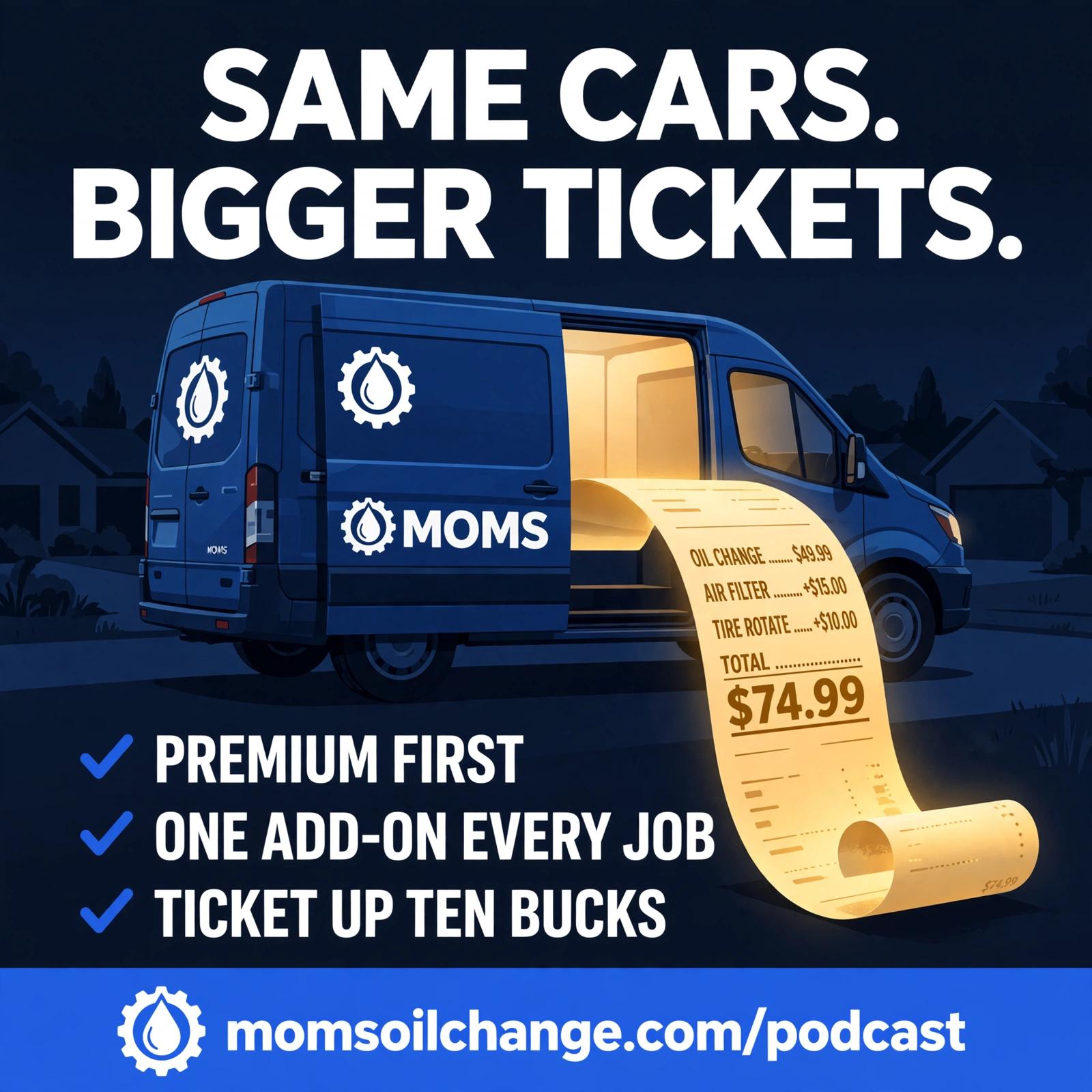
Tyreese: Fourth, and this is the one I want you to take home, stop measuring your week in car count and start measuring it in ticket. Valvoline grew nine point four percent with flat car count. Your growth engine is not more cars. It is a better ticket on the cars you already have. Do the math with me. Ten dollars more per ticket. Five jobs a day, five days a week, fifty weeks a year. That is twelve thousand five hundred dollars a year. No new customers. No new van. No new technician. No new ad spend. Twelve thousand five hundred dollars, from ten dollars a ticket. That is what premiumization actually looks like when it is sitting in your driveway instead of on an earnings call.
Tyreese: And fifth, protect the rating like it is the business, because it is. Four point eight stars is not an accident. It is the moat. Every happy customer gets asked for a review before you leave the driveway. Every unhappy customer gets handled before they ever get to Google. The chains are buying their reputation with national advertising. Yours is free, one driveway at a time.
Tyreese: Here is what it means for independents versus the big chains, plainly. The chains have scale, they have stores, they have a national ad budget, and now we know they have a twenty-year growth machine built on the ticket. We cannot out-build them. We cannot out-spend them. But we do not have to. Our advantage is the driveway, the relationship, and the fact that our ticket can grow the exact same way theirs did, without rent, without a bay, without a franchise fee. They proved the customer will pay more for premium and for convenience. We are the most convenient version of this service that exists. We show up. The play is to charge like it.
Tyreese: So here is your takeaway for this week. Before your first job on Monday, sit down with your price sheet and your last oil invoice. Work out what your oil costs you per job now versus six months ago. Then rewrite your quote so premium full synthetic is first, with one plain sentence on why it is the better choice, and pick your one add-on to offer out loud at every job. Then track one number all week: average ticket. Not car count. Average ticket. If it goes up ten dollars by Friday, you just found twelve thousand five hundred dollars a year hiding in the jobs you were already doing.
Tyreese: Valvoline grew for twenty straight years, not by finding more cars, but by making every car worth more. The cars are already in your driveway. Go make them worth more.
Tyreese: That is the show. Go run your numbers, and I will see you at the next one.
New episodes every weekday. Subscribe via RSS to get them in your podcatcher.
Book Your Oil Change