
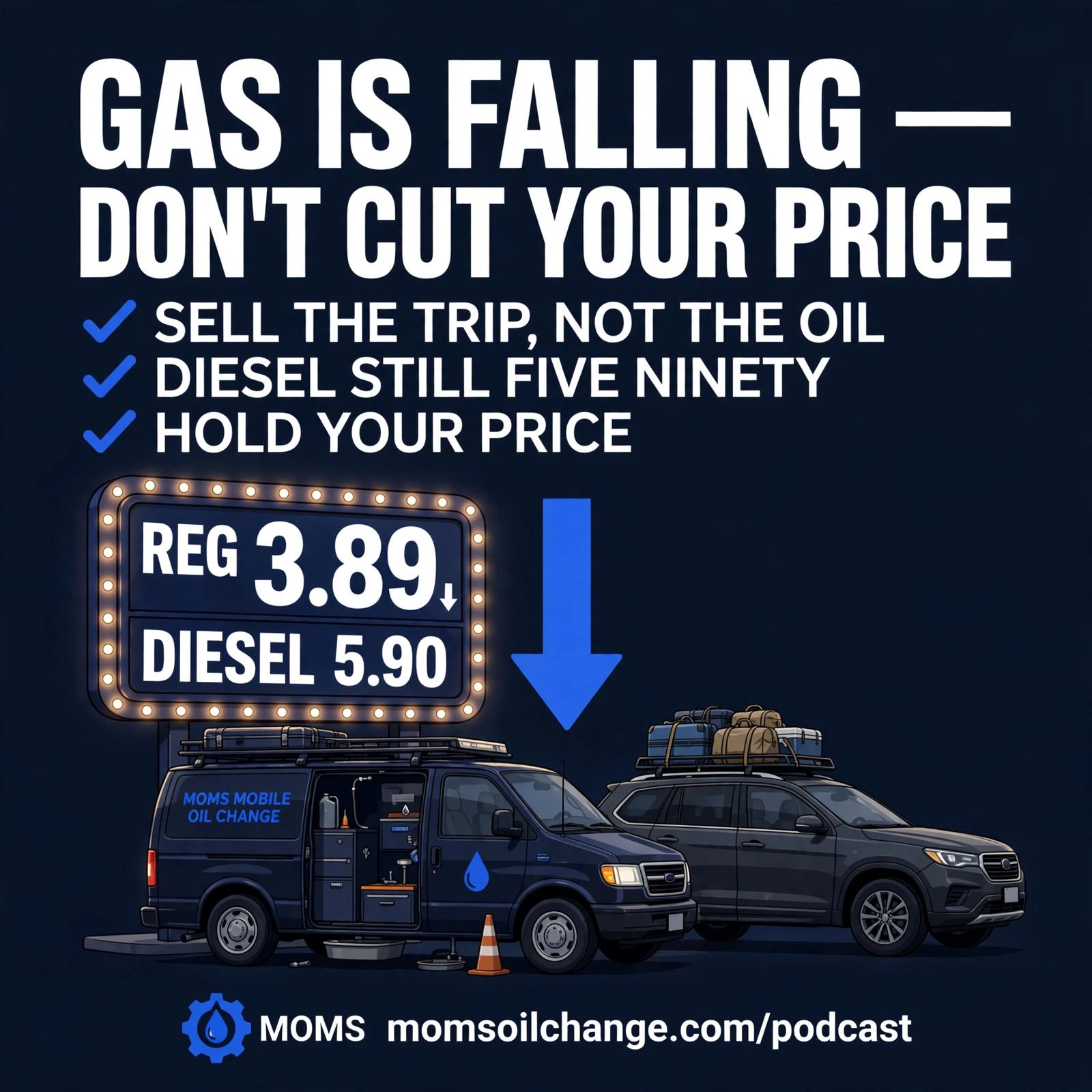
Gas Is Falling Fast — Don't Drop Your Price
Gas is down 60 cents in a month and 72.9 million people are driving for Thanksgiving — but your diesel is still .90. Tyreese's playbook: sell the road-trip-ready visit at full price and bank the margin.
Share this episode
Every share includes a caption, call to action, and hashtags — just pick your platform.
🎙️ Gas Is Falling Fast — Don't Drop Your Price Gas is down 60 cents in a month and 72.9 million people are driving for Thanksgiving — but your diesel is still .90. ... Press play and listen 👇
https://momsoilchange.com/podcast/gas-is-falling-fast-dont-drop-your-price-2026-11-23
#MobileOilChange #momsoilchange #servicewriter #AutoIndustry #SmallBusiness #PhillyBusiness
LinkedIn doesn't accept pre-filled text — we copy the caption for you automatically.
Full Transcript
Tyreese: Look. Monday morning, I'm sitting in the truck outside my first job, and the gas station across the street just changed its sign again. Down. Again. Three dollars and seventy-two cents for regular, and that number has been falling for twenty-six straight days. Twenty-six days. And I want to talk about what that actually means for a guy running trucks, because everybody's going to read the headline, feel good for about five seconds, and then miss the money in it completely.
Tyreese: Here's the thing. Triple-A put out their weekly fuel report this past Thursday, November nineteenth, and the numbers are real. National average for regular gas, three dollars and seventy-two cents a gallon. Down eighteen cents in one week. Down from four dollars and thirty cents just a month ago. That's a sixty-cent drop in about a month. CNN ran the math on Triple-A's data and called it the biggest three-week drop since the two thousand eight financial crisis. And Triple-A says it could drop another fifteen cents by Thanksgiving Day, this Thursday.
Tyreese: Now, seventy-two point nine million people are driving somewhere for Thanksgiving this week. That's Triple-A's forecast, and I covered the travel numbers last Monday. But this show is not about the travel numbers. This show is about the money moving underneath those numbers, and the two completely different ways it hits your business. Because gas falling is good news and bad news at the same time, and which one it is depends on whose tank you're looking at.
Tyreese: Side one is your customer's tank. And this is the good news. A month ago your customer was paying four dollars and thirty cents a gallon. Today they're paying three seventy-two. On a fifteen-gallon fill-up, that's almost nine dollars back in their pocket every single time they stop. Fill up twice a week, that's eighteen bucks a week. Over a month, that's real money to a working family. And here's what most operators miss: when gas is expensive, the customer feels broke, and broke customers postpone maintenance. We saw the numbers on that a couple weeks ago. A third of drivers skipped an oil change this past year because money was tight. So when gas drops sixty cents, your customer walks around feeling a little bit richer, a little bit less squeezed, and a little bit more willing to say yes to the thing they've been putting off. That's your opening. That's the whole game this week.
Tyreese: But side two is your tank. And this is the part nobody's talking about. My van doesn't run on regular gas. Your van probably doesn't either. We run diesel. And diesel is still sitting around five dollars and ninety cents a gallon. Diesel did not get the memo. Diesel is still expensive, still squeezing every mile you drive. So while your customer is celebrating at the pump, your fuel bill barely moved. Your cost per route is basically the same as it was a month ago. If you go out there and start discounting your oil changes because gas is down and everybody feels generous, you are giving away margin you never actually got back. Your costs didn't fall. Only your customer's costs fell. Remember that, because that distinction is worth real money this week.
Tyreese: So here's the playbook. And I'm going to walk you through it the way I'd walk a new operator through it, step by step, because this window is short. Gas usually bottoms out in late fall and early winter, and then it climbs again in late winter when the refineries switch back to summer blend. Analysts are saying prices probably keep drifting down through the end of the year, maybe another ten to twenty cents if oil stays where it is. But spring comes every year. This is a window, not a new normal. Play it like a window.
Tyreese: Step one. Sell the trip, not the oil. This week, seventy-two point nine million people are about to drive somewhere for Thanksgiving. A lot of them are driving old cars, cars that are overdue, cars that have been whispering for a month. Your pitch this week is not an oil change. Your pitch is a road-trip-ready car. You call or text every customer on your book who is anywhere near due, and you say one thing: you're driving to grandma's on Thursday, let me make sure the car makes it there and back. Oil, fluids, tires, a look under the hood. One visit, driveway, done before the holiday. And you sell it at full price. Full price. Because you are not selling them a commodity. You are selling them peace of mind before the biggest driving week of the year. The chains are going to run gas-price promos and coupons this week. Let them. You don't compete with a coupon. You compete with showing up at their house on Tuesday and making the car safe for Thursday.
Tyreese: Step two. Name the savings out loud. This is a small thing and it matters more than you think. When you're standing in the driveway and the customer says yes, say it: gas is down sixty cents from last month, you're saving money at the pump, put a little of it into the car that's carrying your family down the highway. You're not lecturing them. You're connecting two facts they already feel. People make better decisions when somebody says the quiet part out loud. And when they feel like they're spending from a win instead of from a squeeze, they say yes faster, and they say yes to the add-ons too. The cabin filter. The wipers before the winter rain. The stuff they've been putting off. This is the week those yeses come easier. Don't waste it being shy.
Tyreese: Step three. Do not discount into the dip. I want to say this plainly because I know somebody listening right now is thinking about running a gas-prices-are-down sale. Don't. Here's the math. Your oil costs didn't drop. Your filter costs didn't drop. Your diesel is still five ninety. Your labor is still your labor. The only thing that dropped is your customer's gas bill, and that money belongs to your customer, not to your price sheet. If you cut your price now, you train your customers to expect the discount, and when gas goes back up in the spring, you can't put your price back without a fight. The quoted price is the price. I have said that on this show before and I will keep saying it, because it is the rule that keeps a small operator alive. Hold your price. Sell the value. Let the chains race to the bottom. That's their business model, not yours.
Tyreese: Step four. Talk to your fleets about diesel. This is the one most mobile guys sleep on. Your fleet customers are running diesel trucks too, and their fuel line is still bleeding. A fleet manager with ten vans is paying five ninety a gallon across every one of them. So when you call your fleet accounts this week, don't lead with the oil change. Lead with their math. Every truck you service in their lot is a truck that didn't burn fuel and driver time driving to a shop and sitting in a bay. Mobile service is a fuel saver for them, not just a convenience. That's a real pitch, and it's worth real money in a contract conversation. If you've got a fleet prospect you've been meaning to call, this is the week. Their fuel pain is your opening line.
Tyreese: And step five, the one for your own books. Bank the margin while you have it. Your revenue per job is holding because you're not discounting. Your customer's mood is good because gas is down. That gap, that little window where the customer feels flush and your price holds, that's profit. Put it in the bank. Don't spend it on a new tool or a wrap or a toy this week. Winter is coming, and winter in this business means slow weeks, cold driveways, and customers who disappear until spring. The operators who survive winter are the ones who banked the good weeks. This is a good week. Bank it.
Tyreese: Now, what does this mean for independents versus the big chains? The chains are going to do what they always do. They're going to run the holiday promo, the nineteen ninety-nine loss leader, the coupon in the mailbox. And a bunch of customers will go sit in a bay for forty-five minutes to save fifteen bucks, and that's fine. That's their customer. Your customer is the one who values their Tuesday. Your customer is the one who would rather have you in their driveway for twenty minutes than lose an hour of their holiday week in a waiting room with bad coffee. Gas falling doesn't change that. It just makes your customer a little more relaxed when you show up. The chains compete on price. You compete on time. And time is the one thing nobody gets back.
Tyreese: Let me bring it back to the truck, because that's where I started. I'm looking at that gas station sign across the street, three seventy-two and falling, and here's what I know. The price at the pump is not your business. Your business is the driveway, the customer, and the price you quoted. Gas going down puts money in your customer's pocket and confidence in their voice. Your job is to be standing in their driveway this week, before Thursday, with a full-price, road-trip-ready visit and a clear sentence about why it matters. That's the whole play. The news is the doorway. The playbook is the room.
Tyreese: So here's your takeaway, and it's one thing. Before your first job today, text five customers who are due or overdue. Five. Not fifty, five. And the text says this: driving for Thanksgiving? Let me get the car road-trip ready before Thursday. One visit, your driveway, full check. That's it. Five texts, five chances to fill Tuesday and Wednesday at full price, while seventy-two point nine million people are thinking about the road. Gas is falling. Your price isn't. Go run your numbers. I'll see you at the next one.
New episodes every weekday. Subscribe via RSS to get them in your podcatcher.
Book Your Oil Change