
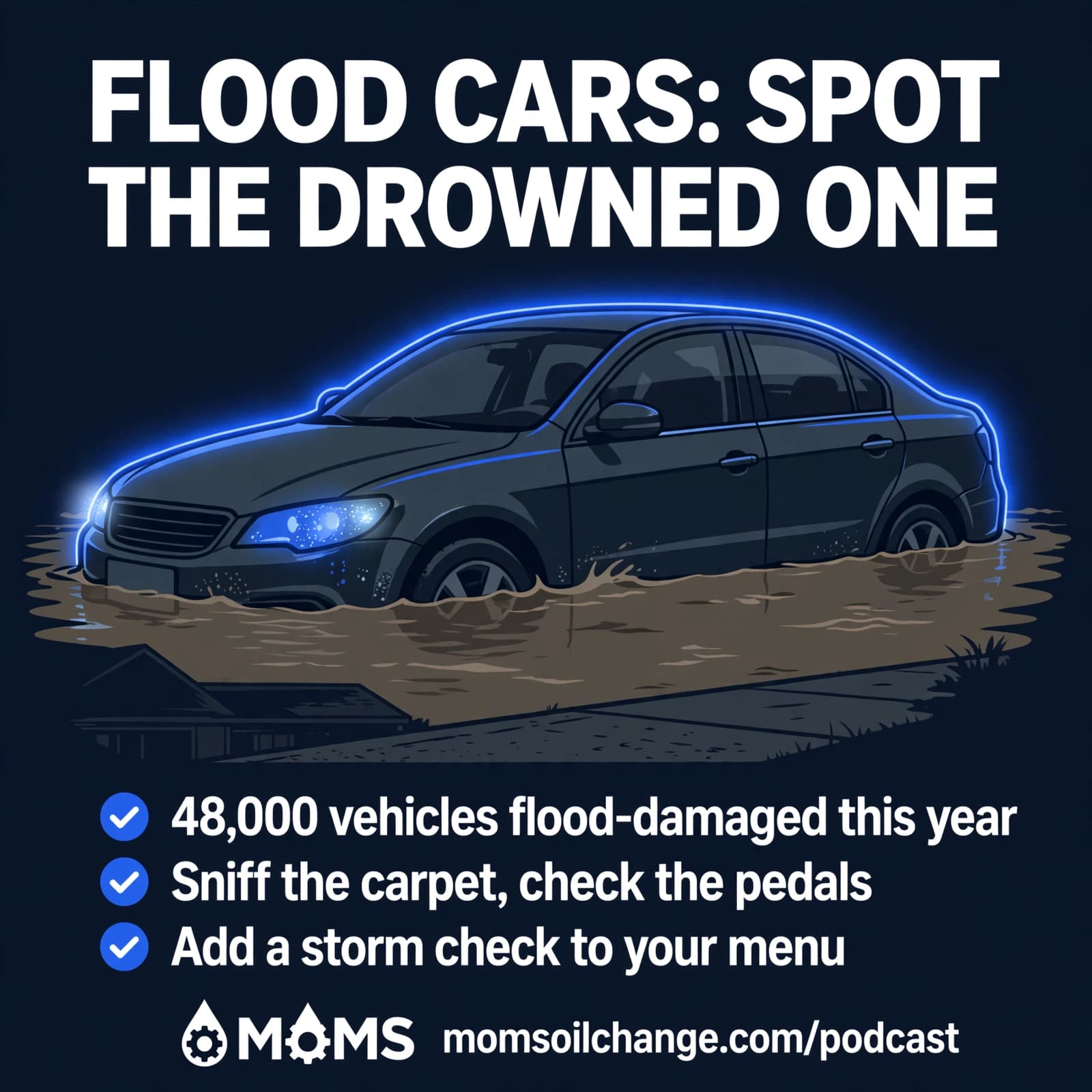
Flood Cars: 48,000 Damaged Vehicles, One Checklist
CARFAX warned this week that up to 48,000 vehicles took flood damage from mid-year storms — Tyreese says a drowned car leaves tells you can spot from the driveway, and why that warning is a mobile operator's best lead of the month.
Share this episode
Every share includes a caption, call to action, and hashtags — just pick your platform.
🎙️ Flood Cars: 48,000 Damaged Vehicles, One Checklist CARFAX warned this week that up to 48,000 vehicles took flood damage from mid-year storms — Tyreese says a drowned ca... Press play and listen 👇
https://momsoilchange.com/podcast/flood-cars-48000-damaged-vehicles-one-checklist-2026-10-20
#MobileOilChange #momsoilchange #servicewriter #AutoIndustry #SmallBusiness #PhillyBusiness
LinkedIn doesn't accept pre-filled text — we copy the caption for you automatically.
Full Transcript
Tyreese: Look, this one came out of nowhere and it matters to you if you run a truck, because these cars are rolling into your route whether you know it or not.
Tyreese: So Tuesday, October thirteenth, twenty twenty-six, CARFAX put out a press release. Hurricane Isaias — first Atlantic hurricane of this year, came through this fall — and CARFAX is warning everybody: watch for flood-damaged cars. They estimate up to forty-eight thousand vehicles took flood damage from storms between April and August. Forty-eight thousand. And here's the part that got my attention. That is new damage, added on top of more than half a million water-damaged vehicles already on American roads. Half a million. Just driving around like nothing ever happened.
Tyreese: Now here's the thing. You would think this is a Gulf Coast story. Some of it is. But the storms that did this damage hit Michigan, Wisconsin, Mississippi, Indiana, West Virginia. Places you would not necessarily associate with flood cars. And law enforcement is telling CARFAX the same thing they say after every storm season. These vehicles get cleaned up, dried out, and they resurface for sale in cities and states far from where the flooding happened. Title-washed, curbstoned, moved across state lines. A customer buys a clean-looking used car in October, and by November it is sitting in a driveway in your territory with mildew in the seats and silt in places silt should never be.
Tyreese: Larry Nutson picked this up in his weekly auto news wrapup Sunday. He put it right next to the byo-oil story — customers bringing their own oil to oil change shops because prices are up. Same theme, really. The money is tight, the market is weird, and the cars on the road are carrying more secrets than usual.
Tyreese: I have seen this movie before. Every few years, after a bad storm season, a flood car shows up on my route. And I am telling you, the tells are there if you know where to look. The car looks fine. It was detailed. Somebody put an air freshener in it and shampooed the seats. But water leaves a trail, and you cannot shampoo away all of it.
Tyreese: Here is what I check, and you can do all of this standing in a driveway. First, pop the door and smell. A musty, moldy smell in the interior — that is the first tell. Air fresheners wear off. Mildew does not. Second, the carpets. Damp carpet, or carpet that feels brand new in a car that otherwise has eighty thousand miles on it. Loose upholstery. Carpeting that is stained, or does not match the rest of the interior. That all means somebody tried to hide what the water did.
Tyreese: Then look for the hard stuff to clean. Rust around the door hinges. Under the dashboard. On the pedals. Inside the hood and trunk latches. Mud or silt in the glove compartment, under the seats, up higher than water should ever reach. Fog or moisture beads inside the headlights, the taillights, the instrument cluster. And the wires. Brittle wires under the dashboard are a tell nobody thinks to fake. Nobody details the underside of a dash. Nobody.
Tyreese: From my lane, the oil change lane, the fluids will tell on a flood car too. Water in the engine oil. Milky transmission fluid. The differential. Pull the dipstick and look at the color, look at the consistency. A car that took water will try to tell you in the fluids before it tells you anywhere else. So when you are doing your normal inspection, just look. That is all. Just look.
Tyreese: Now why am I talking about this on an oil change podcast? Because this is a mobile operator's lane, completely. Think about it. The big chains are not going to flag this. Their bays are volume plays. Car in, car out, fifteen minutes, next. Nobody is sniffing the carpets at a chain. Nobody is crawling under a dash looking for brittle wires when there are three cars stacked behind you.
Tyreese: But you? You are in the driveway. You have your eyes on the car, the customer is right there, and trust is the whole business. CARFAX's own advice says have the vehicle inspected before you buy it. Why should that inspection not be your truck in somebody's driveway? The chains cannot do this play. You can.
Tyreese: Here is the practical takeaway, and there are really two of them. One, this week, put a storm check on your menu. A post-storm inspection. You go over the tells, you run a CARFAX Flood Check with the customer — CARFAX has a free tool for it, carfax dot com slash flood — you check the fluids, you write it all down on the invoice. Charge for the hour, or bundle it with a full synthetic service. Either way it is real value. A person about to drop fifteen thousand dollars on a used car will pay for an hour of your time to tell them whether it has been swimming. And they will remember who told them. That is a customer for life, or at least for every oil change that car ever needs.
Tyreese: Two, talk about it. Short video. Here is what a flood car looks like under the hood. Here is the silt line in the glove box. Here is the fog in the taillight. Nobody else is making that content for their market. You make it, you become the guy people send the used-car listing to before they buy. "Hey, run this past my guy." That is positioning you cannot buy.
Tyreese: One warning, because this matters. Do not overreach. You are not an appraiser and you are not certifying a car as flood-free. You document what you see, you show the customer the CARFAX report, you write it on the invoice, and you let them decide. Flood cars can have electrical gremlins that do not show up for months. Say that out loud. "Everything looks clean today, but water damage can hide. Check the history, drive it, get it checked." Protect the customer, protect yourself. The trust is the asset. Never spend it to sound sure about something you cannot see.
Tyreese: Look, the storm season ends but the cars keep coming. Forty-eight thousand new ones this year. Half a million already out there. And some of them are parked in your market right now with a fresh detail and a clean-smelling air freshener. You cannot stop them. But you can spot them, and you can be the person who spots them for your customers.
Tyreese: That is the takeaway. Add the storm check. Make the video. Write everything down.
Tyreese: That is it for today. Go check a carpet. See you tomorrow.
New episodes every weekday. Subscribe via RSS to get them in your podcatcher.
Book Your Oil Change